REVIEW · MINDELO
Walking tour with traditional music in Mindelo
Book on Viator →Operated by Mindelo Cultural · Bookable on Viator
Music runs the streets of Mindelo. I love how this walk brings you right up to six traditional rhythms, and I love the mix of real neighborhoods with cultural storytelling. In about four hours, you’re not just looking at sights—you’re learning how music and daily life fit together.
I recommend this especially if you want a human guide. Marion (often named as Mairion in messages) leads with genuine Cape Verde energy, wearing the Mindelo Cultural badge and connecting what you see to how people live, work, and celebrate.
One consideration: there’s a lot of uphill walking, and the tour is not suitable for disabled travelers. If you’re not comfortable on hills, plan your day around this pace and wear supportive shoes.
In This Review
- Key highlights to look for
- Entering Mindelo Cultural with Marion: meeting point, pace, and what you get
- Palácio do Povo: why a former governor’s seat still matters
- Walking through everyday commerce at the souvenirs and market stops
- From a Torre de Belém replica to Künstlerhof artisan life
- The commercial and marina area: trade energy and island scale
- Where the music starts early: CNAD and the local sound of freskhinas
- Learning the six rhythms: what to listen for during the music moment
- Food and snack reality: plan for more than a small bite
- Price and value: is $80.26 worth it?
- Who should book this walk (and who should skip it)
- Practical tips before you go
- Should you book Mindelo Cultural’s traditional music walking tour?
- FAQ
- How long is the Mindelo Cultural walking tour with traditional music?
- How much does the tour cost?
- Where does the tour start, and where does it end?
- What kind of ticket do I need?
- How many people are in a group?
- What music experience is included?
- Is the tour suitable for disabled travelers?
- Can I cancel for a full refund?
- Is this tour connected to any social project?
Key highlights to look for
- Six rhythms, taught live: you’ll hear traditional styles explained as part of the music experience
- Stop-by-stop local context: history, society, and culture woven into real streets and places
- Market time with everyday variety: souvenirs, traditional clothing, second-hand items, and groceries
- Artisans and studios at Künstlerhof: creative spaces where you can watch local craft culture at work
- Music in a cultural hub and a local bar: the evening-feel starts on the tour, with stops like CNAD and freskhinas
- Small group feel: a maximum of 20 travelers keeps it personal
Entering Mindelo Cultural with Marion: meeting point, pace, and what you get
This tour starts at Ouril Hotel Mindelo, then loops back to the same meeting point. That matters more than it sounds: you avoid the “end up across town” problem and you can plan the rest of your day with less stress.
You’ll be with a small group (up to 20), guided by someone wearing a Mindelo Cultural badge. In practice, that size helps because you get time for questions, and it stays social without turning into a loud stampede. Also, it’s offered as a mobile ticket experience, so you can keep things simple on your phone.
The tour is designed for people who want the culture side of Mindelo, not just quick photo stops. And there’s a meaningful extra layer: by joining, you support social projects connected to SOS Children’s Village in Mindelo. That doesn’t replace the experience, but it gives the walk a purpose beyond sightseeing.
You can also read our reviews of more walking tours in Mindelo


Palácio do Povo: why a former governor’s seat still matters
Early on, you’ll visit Palácio do Povo, the former seat of the governor. This kind of stop is more than architecture. It gives you a reference point for how power and administration shaped the city you’re walking through now.
What I like about placing history early is that it helps you “read” later places with better context. When you know what a building used to represent, markets, neighborhoods, and cultural spaces feel less random. You start to see patterns in how Mindelo grew—politically, socially, and through trade and island life.
Walking through everyday commerce at the souvenirs and market stops
Next comes a practical, hands-on slice of Mindelo: a place where you’ll find souvenirs from mainland Africa alongside traditional clothing, second-hand items, and groceries. This stop is ideal if you like browsing with your eyes open. You’re seeing what people actually buy and sell, not just what’s meant for tourists.
You’ll also visit a colorful market scene in a historic building. Markets in port cities do two jobs: they feed people and they connect communities. In Mindelo, that connection shows up in the mix—items that reflect both local island culture and wider links across the Atlantic world.
One small drawback: market time can mean time on your feet. Since hills are part of the deal on this tour, this isn’t the best pick if you’re already walking lots that day. But if you enjoy wandering and learning how commerce works, you’ll get a lot from this segment.
From a Torre de Belém replica to Künstlerhof artisan life
One of the most fun surprises on this walk is the replica of the famous Torre de Belém in Lisbon. Mindelo has its own geography and history, so seeing a direct reference like this helps you understand the cultural echoes that island communities maintained over time.
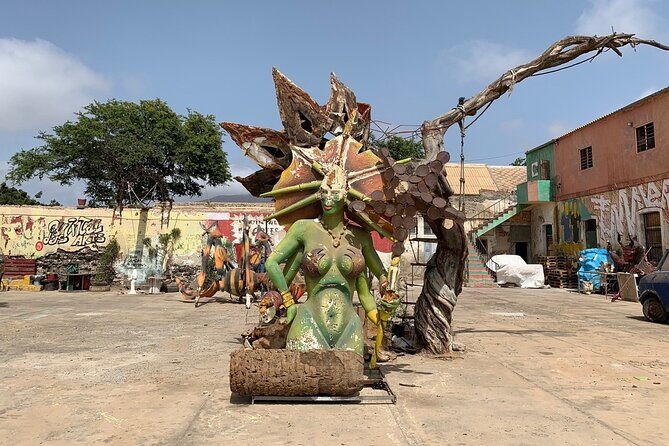
After that, you’ll head to Künstlerhof, where artisans work in creatively designed studios and shops. This is the part of the tour where you slow down a bit and look at craft as a living practice.
What makes Künstlerhof worth your attention is that it’s not just a display. You’re moving through a creative space and getting a sense for how people turn skill into livelihood. If you like shopping for meaning (rather than only buying), this is where you can focus.
The commercial and marina area: trade energy and island scale
You’ll also see the largest commercial and marina of the Cape Verde Islands. For many visitors, this is one of those “oh, so this is why Mindelo feels like a crossroads” moments.
Even without fancy explanations, ports tell stories: goods move through, people pass through, and the city’s rhythm adapts. This stop helps you connect what you’ve learned about culture with what you can see about the economy—how a place sustains itself and why music and social life often thrive around busy public spaces.






Where the music starts early: CNAD and the local sound of freskhinas
The tour’s central promise is traditional music, and it delivers by taking you to cultural stops where sound is part of the environment, not an optional performance.
A highlight from the experience is time at CNAD, where a musician and dancer explain and teach the six rhythms of the islands. If you’ve ever listened to Afro-Caribbean music and wondered what you’re hearing beyond the surface, this is where you start getting the structure. You’re not just watching; you’re learning.
In one memorable moment shared by a guide experience, a musician named Dzhen performs and helps carry the evening-feel while you enjoy a local beer at a bar called freskhinas. That’s a key difference from tours that only point you at a stage. Here, music feels woven into a local hangout routine.
Learning the six rhythms: what to listen for during the music moment
So you hear six traditional rhythms—great. But what should you actually do with that as a listener?
I’d treat this like a mini music lesson with walking-tour energy. Pay attention to patterns: how rhythm changes between sections, how dancers respond, and how the musician frames what you’re hearing. When someone explains the role of each rhythm style, your ear starts recognizing differences faster.
This matters because Cape Verdean music is easy to enjoy, but harder to understand without context. Getting that context during the tour turns the final music time into a skill you keep. Later that night, if you hear something similar in a bar, you’ll recognize what type it is.
Also, because it’s a walking tour, the music moment doesn’t feel like a random break. You’re already thinking about culture, markets, and community. Then the rhythms click into place as a real expression of everyday life.
Food and snack reality: plan for more than a small bite
The tour notes mention a snack-style element, and that lines up with what I’d expect for this kind of cultural session. In practice, this experience often includes more than a tiny snack.
One guide-led moment described a full meal along with music from local musicians. Another experience included fresh juices and small Cape Verde snacks, and one solo participant was even provided a spontaneous vegan snack while a singer shared insight into the variety of Mindelo sounds.
So my advice: don’t schedule a big lunch right before this. Even if it varies a bit by version and group flow, the tour is set up so you’ll leave having eaten and having had real local music in the same block of time.
Price and value: is $80.26 worth it?
At $80.26 per person for about four hours, this is not the cheapest walk in Mindelo. But it earns its price in specific ways:
- You’re paying for live cultural instruction, not only sightseeing. Six rhythms explained with a musician (and often dance) is the core value.
- You get multiple stops that connect history, artisan culture, and port-city life—Palácio do Povo, market areas, Künstlerhof, and the marina.
- It’s small-group (max 20), so the session doesn’t lose its personal feel.
- You’re supporting social projects linked to SOS Children’s Village in Mindelo, which adds meaning to the money spent.
It’s also a tour with strong demand—booked about 22 days in advance on average. If your dates are fixed, I’d book sooner rather than later to avoid the “it’s sold out” problem, especially if you’re traveling during busy seasons.
Who should book this walk (and who should skip it)
You should book this if:
- you want traditional Cape Verde music with explanation, not just background entertainment
- you enjoy markets, artisan stops, and learning the city’s social side
- you’re the type who likes to ask questions and follow a guide’s stories through neighborhoods
You might skip or choose a different plan if:
- you have limited mobility or need an accessible route (this one is not suitable for disabled travelers)
- you hate uphill walking or you want a flat, low-effort activity
Solo travelers are not an issue here. Most people can participate, and the format supports meeting the guide and group without feeling awkward.
Practical tips before you go
- Wear comfortable shoes. Hills are mentioned as part of the experience, and the tour is active across multiple stops.
- If you’re picky about timing, treat this as a half-day commitment. Four hours goes fast once music and market stops are in play.
- Bring curiosity. The best moments often come when you lean into questions about why certain rhythms matter and what you’re seeing in daily life.
Should you book Mindelo Cultural’s traditional music walking tour?
My honest take: book it if your goal is to understand Mindelo through sound and street-level culture. The tour’s structure connects key sites—Palácio do Povo, markets, Künstlerhof, and the marina—to the main event: learning the six rhythms with live musicians, sometimes with dance, plus a food moment that can be more substantial than you expect.
Skip it if you need fully accessible routes or if you want a gentle, flat walk. Otherwise, this is a smart way to get your bearings fast and leave with more than photos: you’ll leave with a clearer ear for Cape Verdean rhythms and a better sense of how Mindelo’s culture actually runs.
FAQ
How long is the Mindelo Cultural walking tour with traditional music?
It’s about 4 hours.
How much does the tour cost?
The price is $80.26 per person.
Where does the tour start, and where does it end?
The tour starts at Ouril Hotel Mindelo in Mindelo, Cabo Verde and ends back at the same meeting point.
What kind of ticket do I need?
You’ll receive a mobile ticket.
How many people are in a group?
The tour has a maximum of 20 travelers.
What music experience is included?
You’ll hear and learn traditional Cape Verdean music, including six traditional rhythms, with help from an excellent musician (and sometimes dance).
Is the tour suitable for disabled travelers?
No, it is not suitable for disabled travelers.
Can I cancel for a full refund?
Yes. You can cancel up to 24 hours in advance for a full refund. If you cancel within 24 hours, there’s no refund.
Is this tour connected to any social project?
Yes. Participation supports social projects of SOS Children’s Village in Mindelo.